

This project is funded by European Innovation Council (Horizon-EIC-2024-PathfinderOpen-01 ReverseStroke n°101187647) and the Swiss State Secretariat for Education, Research and Innovation (SERI)

From violinists to metal welders, finely tuned hand and arm movements are the foundation of craft, while all of us rely on proficient use of hands for the activities of daily life. Yet, more than 25 million people worldwide lost functional movements to subcortical stroke.
Subcortical stroke often interrupts the communication between the cortex and the cervical spinal cord circuits, which leads to permanent hand and arm paralysis. The result is a vastly reduced quality of life and enormous socioeconomic burden for the affected, their families, and the society. A treatment that can effectively restore functional movements after subcortical stroke does not yet exist. Still, the motor cortex, which orchestrates movements, and the spinal cord motor circuits that directly control muscles remain largely intact. We aim to reverse the hand and arm paralysis of people with subcortical stroke by developing a digital bridge that reconnects the motor cortex with the cervical spinal motor circuits. This brain-spine interface consists of fully-implantable recording and stimulation systems that link cortical signals to spatiotemporal sequences of epidural electrical stimulation targeting spinal cord regions involved in the production of hand and arm movements. Our preliminary results in people with spinal cord injury strongly indicate that the brain-spine interface can restore natural control of movement and promote neurological recovery. Therefore, we are confident that a cervical brain-spine interface can reverse hand and arm paralysis incurred by stroke and, therefore, become a viable treatment option for subcortical stroke survivors.
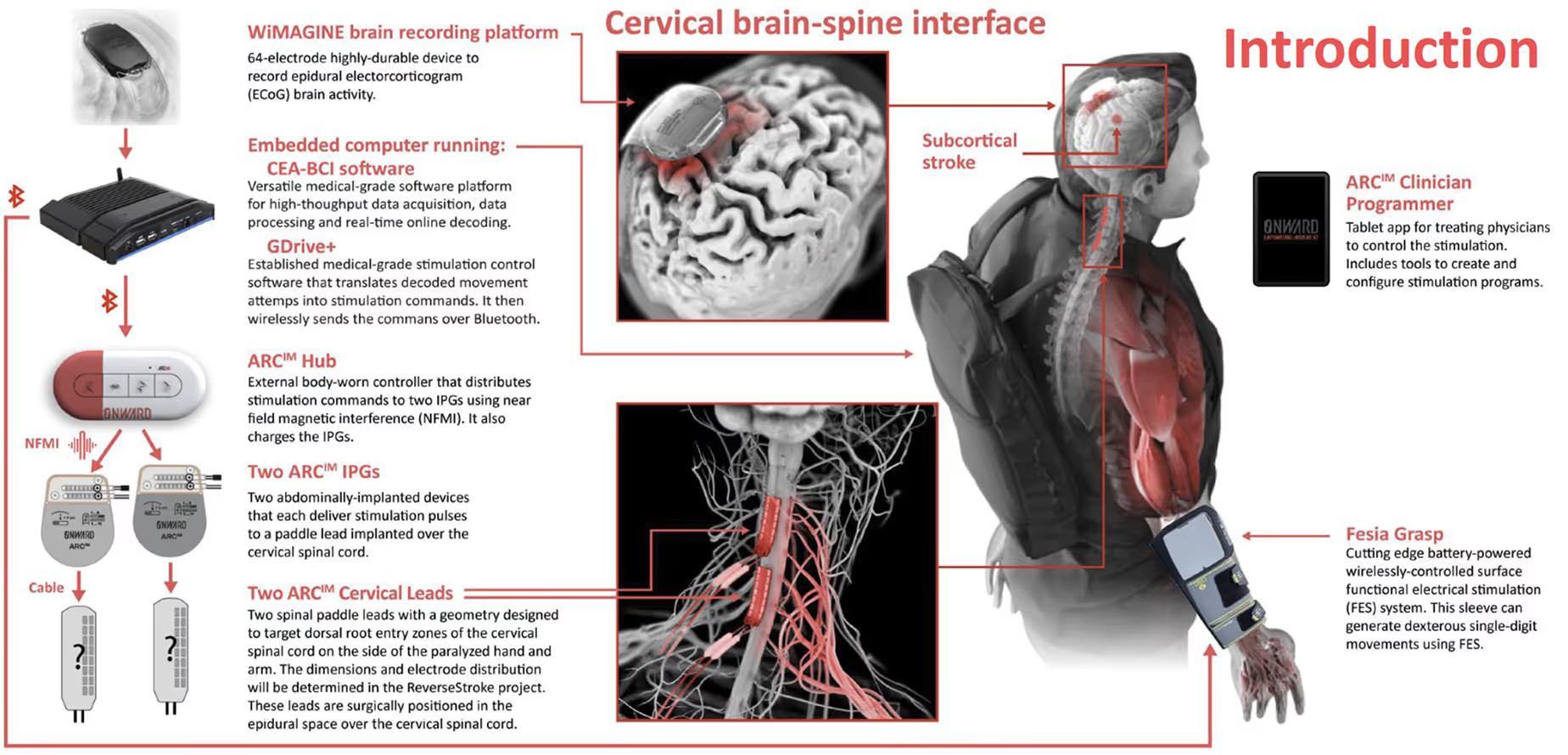





ONWARD Medical is the leading neurotechnology company pioneering therapies to restore movement, function, and independence in people with spinal cord injuries (SCI) and other movement disabilities. Building on decades of scientific discovery, preclinical research, and clinical studies conducted at leading hospitals, rehabilitation clinics, and neuroscience laboratories, the Company developed its proprietary ARC Therapy. It has subsequently been awarded 10 Breakthrough Device Designations from the FDA. The Company's ARC EX® System is cleared for commercial sale in the US and Europe. The Company is also developing an investigational implantable system called ARC-IM®, designed to address several unmet needs including blood pressure instability after spinal cord injury. It can also be paired with a brain-computer interface (BCI) and artificial intelligence (AI) to restore thought-driven movement.
Headquartered in the Netherlands, the Company has a Science and Engineering Center in Switzerland and a US office in Boston, Massachusetts. The Company is listed on Euronext Paris, Brussels, and Amsterdam (ticker: ONWD) and its US ADRs can be traded on OTCQX (ticker: ONWRY).
To learn more about ONWARD Medical's commitment to partnering with the spinal cord injury community to develop innovative solutions for restoring movement, function, and independence after spinal cord injury, please visit ONWD.com.

.png)
The Clinatec biomedical research center is within the CEA Grenoble, a research technological center of French Alternative Energies and Atomic Energy Commission. Clinatec combines medical research and technological innovation at the same place to translate new solutions to patients. R&D is conducted by the CEA and the Grenoble University hospital (CHUGA) oversees clinical trials. The Clinatec's mission is to accelerate the development and clinical validation of innovative medical devices based on medical needs and using state-of-the-art technologies.
Clinatec develops new treatments, diagnostics and research methods for applications in neurodegenerative disease and spinal-cord injury. A multidisciplinary team made up of clinical practitioners, biologists, mathematicians and engineers in microtechnology, nanotechnology and signal processing has been constituted at Clinatec to drive innovation in micro and nanosystems for healthcare. The platform's unique approach—bringing together a broad range of know-how at a single location—fosters the emergence of novel solutions and speeds up proof-of-concept testing and transfer of new technologies to manufacturers. The ultimate goal is to offer new solutions to as many patients as possible.
.svg)
Located in Switzerland, EPFL (www.epfl.ch) is one of Europe's most vibrant and cosmopolitan science and technology institutions. EPFL has both a Swiss and international vocation and focuses on three missions: teaching, research and innovation. EPFL collaborates with an important network of partners, including other universities and colleges, secondary schools and gymnasiums, industry and the economy, political circles and the general public, with the aim of having a real impact on society.
Associated to EPFL, the .NeuroRestore center (www.neurorestore.swiss) is a research, innovation and treatment center that develops and applies bioengineering strategies involving neurosurgical interventions to restore neurological functions. .NeuroRestore integrates implantable neurotechnologies and innovative treatments resulting from rigorous preclinical studies that have been conducted during the last 15 years in rodent and non-human primate models. These developments have led to breakthroughs for the treatment of paraplegia, tetraplegia, Parkinson's disease, stroke, and traumatic brain injuries.

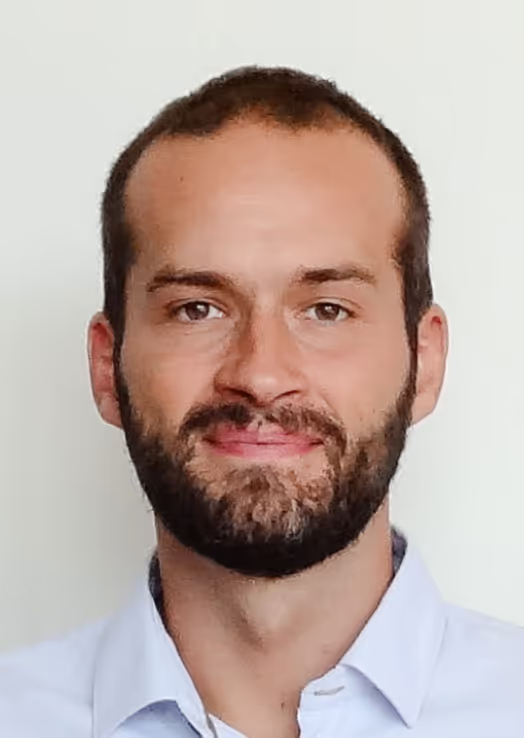
Dessintey was born from a collaboration between Davy, Nicolas Fournier and the University Hospital of Saint-Étienne, where Davy completed his Master's research alongside Pr. Pascal Giraux. Their work focused on mirror therapy and the development of a unique visual feedback approach that would later lead to IVS3 (Intensive Visual Simulation), Dessintey's pioneering solution designed to stimulate brain plasticity and accelerate motor recovery after neurological injuries.

.png)
DTS is Intellectual Property Law Office with offices in Munich, Stuttgart and Zurich. It was founded more than 20 years ago in Munich and is now providing counsel to clients including private inventors, SMEs but also blue chip companies. DTS is regularly ranked as a recommended IP Law Office by Financial Times Europe or JUVE.

Karolinska Institutet is one of the world's leading medical universities. The vision is to advance knowledge about life and strive towards better health for all. Karolinska Institutet accounts for the single largest share of all academic medical research conducted in Sweden and offers the country's broadest range of education in medicine and health sciences. The Nobel Assembly at Karolinska Institutet selects the Nobel laureates in Physiology or Medicine.


The Lausanne University Hospital (CHUV) is one of the five Swiss university hospitals and ranks among the top 15 best hospitals in the world, according to Newsweek magazine's 2024 ranking.
Thanks to its collaboration with the Faculty of Biology and Medicine at the University of Lausanne (FBM), the CHUV plays a leading role of European significance in the fields of medical care, medical research, and education.

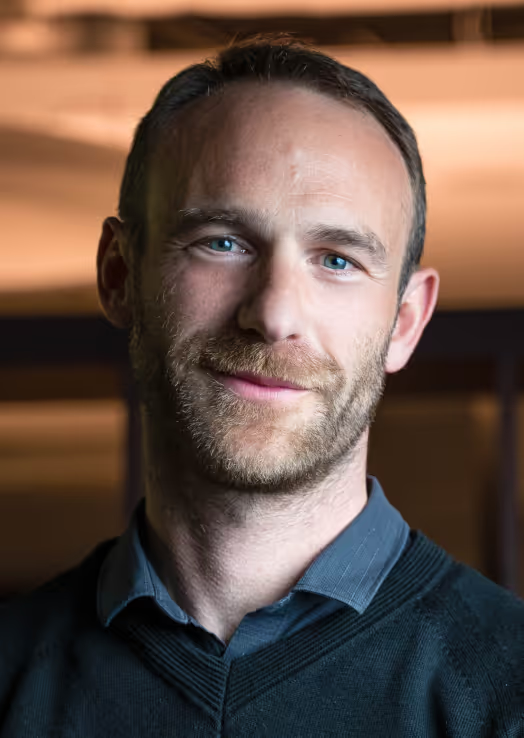
Faithful to its spirit of innovation and openness to the world, Unil offers its 17,000 students a rich and varied education. The excellence of its research and its international outlook enable the University of Lausanne to offer a rigorous and productive academic environment to the nearly 3,000 researchers who work here.
Unil is made up of seven faculties: Business and Economics (HEC Lausanne); Arts; Theology and Religious Studies (FTSR); Social and Political Sciences (SSP); Law, Criminal Justice and Public Administration (FDCA); Biology and Medicine (FBM); and Geosciences and Environment (GSE), the last three of which are unique in Switzerland.
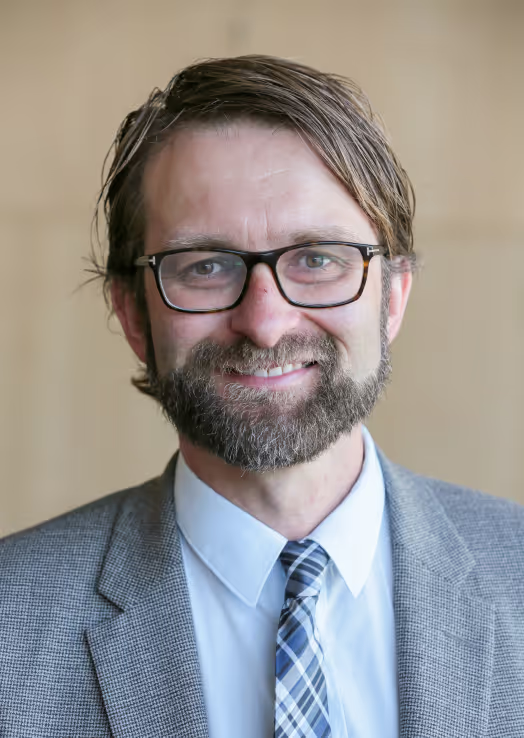
Located in Switzerland, EPFL (www.epfl.ch) is one of Europe's most vibrant and cosmopolitan science and technology institutions. EPFL has both a Swiss and international vocation and focuses on three missions: teaching, research and innovation. EPFL collaborates with an important network of partners, including other universities and colleges, secondary schools and gymnasiums, industry and the economy, political circles and the general public, with the aim of having a real impact on society.
The Defitech Chair of Clinical Neuroengineering, led by Friedhelm Hummel, focuses on developing innovative neurotechnologies to restore brain function in neurological disorders. The team combines non-invasive brain stimulation, neuroimaging, computational modeling, and behavioral neuroscience to investigate and modulate human brain circuits in a targeted and personalized manner. A central goal is to translate mechanistic insights into clinically applicable interventions for conditions such as stroke, traumatic brain injury, or neurodegenerative disorders with motor and cognitive impairment. Through interdisciplinary work we advanced circuit-based, precision neuromodulation strategies with breakthroughs in non-invasive deep brain stimulation. Its work bridges fundamental neuroscience and clinical application to promote recovery, resilience, and adaptive brain plasticity.

Graylight Imaging is a medical technology company specializing in advanced software and artificial intelligence (AI) solutions for diagnostic image analysis. The company develops innovative technologies for automated interpretation of CT, MRI, and angiographic imaging, helping healthcare providers improve diagnostic accuracy, streamline clinical workflows, and support data-driven decision-making.
Building on deep expertise in medical imaging, AI, and software engineering, the company delivers custom applications, software platforms, and AI algorithms for clients worldwide. Graylight Imaging partners with organizations across the healthcare ecosystem, including medical device manufacturers, healthcare providers, and pharmaceutical companies, developing solutions tailored to their specific clinical and business requirements. Its technologies are utilized internationally, with clinical implementations validating their practical value in real-world healthcare environments.
To learn more about Graylight Imaging's mission to advance medical imaging through AI-powered innovation, please visit Graylight Imaging.
.svg)


General recommended lectures
1. EC - CORDIS Results Pack Ethics and Integrity in Research – Building a culture of trust and excellence, May 2024.
https://cordis.europa.eu/article/id/450170-ethics-and-integrity-building-bridges-for-trust-and-excellence-in-research-and-innovation
2. COMMON HUMAN RIGHTS CHALLENGES RAISED BY DIFFERENT APPLICATIONS OF NEUROTECHNOLOGIES IN THE BIOMEDICAL FIELD.
Report commissioned by the Committee on Bioethics (DH-BIO) of the Council of Europe, Ienca M., 2021.
https://www.researchgate.net/publication/356412675_COMMON_HUMAN_RIGHTS_CHALLENGES_RAISED_BY_DIFFERENT_APPLICATIONS_OF_NEUROTECHNOLOGIES_IN_THE_BIOMEDICAL_FIELD/citation/download
Specialized recommended lectures
3. Neuroethics and brain-computer interfaces (BCIs), Eran Klein et al. Brain-Computer Interfaces, 2016, 3(3), 123–125.
https://www.tandfonline.com/doi/epdf/10.1080/2326263X.2016.1210989?needAccess=true
4. Four ethical priorities for neurotechnologies and AI, Yuste R, et al. Nature. 2017 Nov 8;551(7679):159-163. doi: 10.1038/551159a
https://www.nature.com/articles/551159a
5. Understanding the Ethical Issues of Brain-Computer Interfaces (BCIs): A Blessing or the Beginning of a Dystopian Future? Livanis E, et al., 2024,Cureus, 14;16(4):e58243. doi: 10.7759/cureus.58243
https://www.ncbi.nlm.nih.gov/pmc/articles/PMC11091939/pdf/cureus-0016-00000058243.pdf